
Key Points
- Your everyday walk can become Qigong when you bring upright posture, natural breathing and present-moment attention to it.
- The exercise is about walking with intent. But don’t do it to slowly or you’ll look odd!
- You can practise for five minutes on the way to a lecture, meeting or bus stop, without special clothing, equipment or extra time.
- Attention rests on the soles of the feet, the breath and lifting the head while remaining alert to traffic and other people.
- Walking Qigong complements, rather than replaces, regular classes where a teacher can refine posture, breathing and movement.
How can an ordinary walk become a genuine Qigong practice?
The short answer is simple: walk as you normally would, but stop giving the journey entirely to your phone, your worries or the pressure to arrive quickly. Let the body move naturally while you become quietly aware of posture, breathing, footsteps and the space around you.
In the Lee Family Taoist Arts, practice is not limited to a mat, a training hall or a dedicated hour in the morning. As explored in Practice Matters and The Benefits of Morning Training, consistency matters because the arts are intended to become part of everyday life.
You can incorporate “Tai Chi ” walking on your walk to university, work or the bus stop.
Qigong begins when that movement becomes more focused, connected: body, breath and attention working together.
This does not mean walking in an unusual way. You do not need to close your eyes, count every step or make your breathing conspicuous. Then you really would look strange!
You are simply learning to move with less internal noise and more consciousness.
Why is relaxed movement more useful than intense stretching?
Many people respond to stiffness by stretching harder. Sometimes that may feel pleasant, but everyday discomfort is often made worse by remaining in the same posture for too long: sitting at a desk, looking down at a screen, standing in one position or travelling without changing how the body is held.
A short walk changes the relationship between the joints, spine and breath. Rather than trying to force the body open, you allow it to move regularly and comfortably throughout the day.
This is close to the Taoist quality of water. Water does not strain to find its way forward. It adapts, continues and follows the available path. In walking Qigong, “don’t force it” means that you do not turn a gentle practice into another task to perform correctly.
Let your pace remain suitable for where you are going. You should still be able to notice crossings, cyclists, other pedestrians and changes in the pavement.

What should your posture feel like while walking?
Begin with the larger areas of the body rather than trying to correct every detail.
- Lift the head and feel it lightly suspended from the crown. Try not to look down.
- Allow the shoulders to drop away from the ears
- Feel the different parts of your foot meeting the pavement.
“Head suspended” does not mean pulling the chin back or lengthening yourself into a military posture. “Shoulders dropped” does not mean collapsing. The aim is a balanced middle position in which you are neither braced nor slumped.
Notice what changes when you stop carrying your shoulders towards your ears. Often, the first improvement is not dramatic. The walk simply feels less effortful.
How should you breathe while walking?
Start with natural abdominal breathing. This means allowing the lower abdomen to soften and gently expand as you breathe in, then return naturally as you breathe out. Do not push the belly out, pull it in or take larger breaths than your body wants.
In traditional Taoist understanding, breath is closely related to Qi, often translated as life energy or vitality. Qigong uses movement, breathing and attention to cultivate a more harmonious relationship between them. This is a traditional framework, not a medical measurement or a promise of treatment.
The practical lesson is modest: a few minutes of comfortable walking and breathing may help you arrive feeling more settled. It is not necessary to claim more than that.
Where should your attention go?
You can use three simple points of attention:
- The soles of the feet: Feel the alternating contact of left and right foot with the ground.
- The breath: Notice whether breathing is easy, shallow, hurried or relaxed, without trying to control it aggressively.
- The surroundings: Be aware of the movement of other people around you
This is walking meditation, but it is also practical awareness. The aim is not to withdraw from the world. It is to be more present through focusing on your body rather than experiencing the whole journey through a screen or your head. You can practice this for 5 minutes daily.

What is the shorter walking reset between lectures or meetings?
When five minutes feels impossible, use three breaths and ten attentive steps.
As you stand up, notice where your weight is. Let the shoulders drop and allow the spine to move out of the shape it has held while sitting.
Walk for ten steps without looking at your feet. Feel the feet, allow one natural breath, and look around you. Then continue at your normal pace.
This small reset is especially useful after a long seminar, a screen-heavy meeting or a bus journey. It is not a substitute for changing position regularly, but it gives you a simple reason to move before stiffness accumulates.
For more specific autumn breathing work, see the separate seasonal breathing reset in Sea Cloud’s blog library. That practice has a more direct focus on breathing and the traditional Metal element. This walking practice is deliberately different: it places breath inside ordinary movement.
Why does walking Qigong suit life in Leeds?
A practice is easier to continue when it does not require you to create an entirely new part of the day. Students walking between halls, young professionals travelling into the city and local residents going to the shops already have natural opportunities to practise.
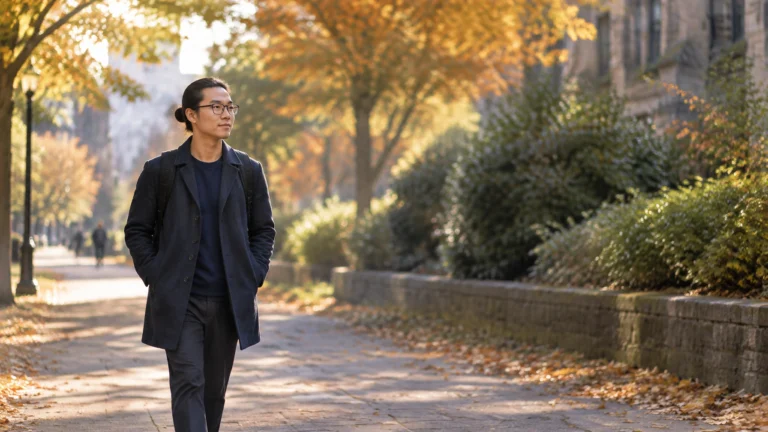
There is no kit, membership or hour to protect in your diary. You can practise in a coat, with a backpack, on a familiar route and at a pace that fits your destination.
Early autumn and the return of term bring darker mornings, fuller timetables and more transitions between places. A few attentive minutes can give the start of the day a different quality without pretending that a commute should become a retreat.
For further guidance on how prolonged sitting affects the body, read Desk to Tao: How Lee Family Taoist Yoga Is Fixing What 9-to-5 Breaks. You can also explore the Lee Family Qigong page for the wider relationship between movement, breath and intention.
Can walking replace a Qigong class?
Walking can become a meaningful part of practice, but it does not replace learning with a teacher. In class, you receive guidance on alignment, breathing, movement quality and the deeper principles of the Lee Family Arts.
At Sea Cloud Hall in Kirkstall, Leeds, beginners’ courses take place at Sandford Place, Kirkstall, Leeds LS5 3AG. The hall is a few minutes from Headingley and Leeds city centre, with public transport access and free parking nearby.
Classes are designed for adults of all ages, including university students, busy professionals and complete beginners. You do not need previous experience, a particular level of fitness or exceptional flexibility.
Frequently asked questions
Do I have to walk slowly?
No. Walk at a pace that is safe and practical. The important change is not speed but awareness, relaxation and the absence of unnecessary force.
Should I breathe in and out through the nose?
Breathe in the way that feels natural and comfortable for you. Do not force nasal breathing or hold the breath, particularly while walking uphill or carrying a bag.
What if I become distracted?
That is normal. Notice that attention has wandered and return to the feet, breath or surroundings. This return is the central skill, not a sign that you have done something wrong.
Can I practise while listening to music?
For a short walking practice, it is usually more useful to leave your headphones off so you can remain aware of traffic and your surroundings. If you do listen, keep the volume low and your attention available to the environment.
Is this suitable if I have pain or a health condition?
Keep the practice comfortable and stop if walking causes concerning or worsening symptoms. Qigong can be adapted, but personal medical advice should come from an appropriate healthcare professional.
What is the simplest way to begin?
Your walk does not need to become perfect before it becomes practice. Start with ten attentive steps, then try the five-minute version when you have more time.
The Lee Family Taoist Arts invite us to bring practice into ordinary life: to move, breathe and pay attention while life is actually happening. If you would like to explore this more fully, join the invitation list for the next Leeds beginners’ course at Sea Cloud Hall.
#QigongLeeds #TaiChiLeeds #WalkingMeditation #TaoistArts
