
Key Points
- Young people are not worse, lazier or less intelligent than previous generations; they are growing up in different conditions with material consequences.
- Taoist Arts offer time away from screens, movement, concentration and direct contact with other people.
- Traditional practice builds confidence through patience, repetition and becoming capable rather than through comparison.
- A welcoming martial arts class can provide belonging, continuity and a safe place to learn from difficulty.
- Ancient wisdom from the Taoist Arts can help be a tool to navigate modern life and can offer some of what modern life is missing.
Growing up has changed.
Young people today spend more time online, experience more pressure and report higher levels of anxiety, difficulty concentrating, low self-esteem and lack of purpose than previous generations. That does not mean there is something wrong with young people.
Writing about the challenges facing young people in Britain, sociologist William Davies quotes the interim Milburn Review:
“Not worse. Not lazier. Not less intelligent. But different in ways that have material consequences.”
Davies discusses this in his 2026 article, “Young People Are Different”, for the London Review of Books. The point is important because it changes the question.
Perhaps the question is not: what is wrong with young people?
Perhaps it is: what are young people missing?
What can help young people get out of their heads?
A great deal of modern life happens through a screen.
Messages, lectures, entertainment, work, socialising and news can all arrive through the same small rectangle. Even when someone is physically present, attention can be pulled somewhere else by a notification or an endless stream of new information.
Taoist Arts such as Kung Fu and Tai Chi offer a different experience.
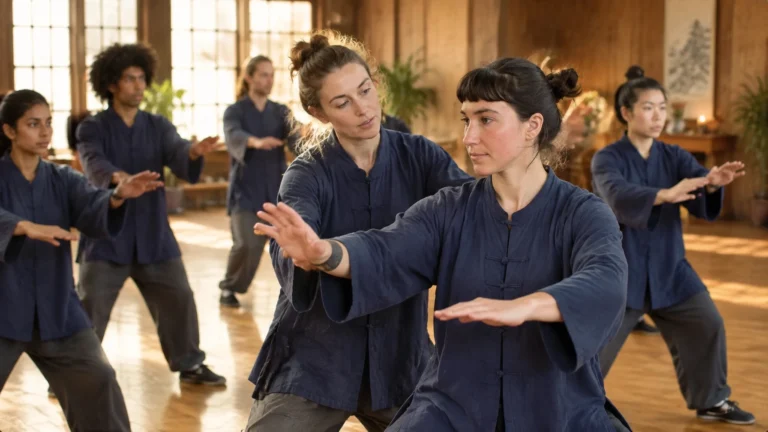
We move. We balance. We learn how to use our bodies. We work with and connect with others. You have to concentrate on what is happening right now.
For an hour, there is nothing to scroll and no notifications to check. You are not being asked to construct an argument or compare your life with somebody else’s carefully edited version.
You are simply there, paying attention to your feet, your hands, your breathing, the movement of the person beside you and the instructions from the instructor.
This is not an argument that screens are always harmful or that young people should reject technology. It proposes that balancing the screens with regular real life experiences that technology cannot provide.

How can young people build confidence by getting good at something?
Confidence does not have to come from somebody telling you to “believe in yourself”.
There is another way to build it.
Try something difficult. Be rubbish at it. Practise. Enjoy the challenge. Get a little better. Keep going until one day you realise you can do something you could not do before.
That is how traditional Arts work.
At first, a movement may feel unfamiliar. Your balance may disappear. Your arms may not go where you expect them to go. Other people may seem to understand something that you cannot yet feel.
None of that means you are rubbish and do not belong in the class.
The challenge is not to be the best person in the room. It is to become better than you used to be. Progress is measured incrementally through consistent practice rather than through comparison.
This is key, because confidence built through actual experience has a different quality from confidence built through praise or a finishing a computer game. When you have struggled with something, stayed with it and gradually improved, you have evidence in your body, not just in your head, that you can overcome difficulty.
That lesson can extrapolate outside the training hall into life.
Could a martial arts class provide somewhere to belong?
Davies highlights a particularly worrying change: between 2003 and 2022, Britain experienced the sharpest fall of any OECD country in teenagers’ reported sense of belonging at school.
That matters because everyone needs somewhere they feel part of.
A traditional martial arts class can become one of these places. You train with the same people each week, learn from people who are further ahead, help others and gradually become familiar with a group of people who are going through the same experiences as you.
Eventually, you may be the person teaching someone new.

This kind of belonging is not based on being cool, successful or naturally talented. You do not have to arrive with the trendy clothes, know anyone or have previous martial arts experience.
At Sea Cloud Hall in Kirkstall, Leeds, classes are welcoming and non-competitive. Beginners are expected. People learn at different speeds, and the training includes space for both concentration and laughter.
There is also something valuable about belonging to a tradition that is bigger than you.
You are not just attending an activity; you are learning practices, a way of life that has been passed from teacher to student through the Lee Family Taoist Arts.
What can Taoist Arts teach about difficulty?
You will get challenged.
That is part of the point.
In a Taoist Arts class, finding something difficult does not mean that you have failed. It usually means that you have found the edge of what you currently understand. You are venturing outside your comfort zone.
You try again.
You might need a clearer explanation. You might need to slow down. Sometimes you need to stop forcing the movement and allow your body to learn through repetition.
Over time, you develop patience, concentration and coordination without necessarily noticing that you are developing them. You also learn that progress is rarely smooth. Some days feel easy; other days, a familiar movement seems to have disappeared.
This is one reason we do not treat physical training as a performance and we do not take part in competitions. Gentle, consistent practice is more useful than trying to prove yourself the best.
The same principle applies outside the class. A missed deadline, awkward conversation or disappointing result may be difficult, but it does not have to become a final judgement on your ability.
Why might an ancient practice feel relevant now?
Taoist Arts developed long before smartphones, social media and online gaming.
Yet some of what they teach feels particularly relevant to modern life:
- Attention instead of distraction.
- Movement instead of remaining in one posture for too long.
- Real people instead of a screen.
- Patience instead of instant results.
- Progress instead of comparison.
- Confidence through actually becoming capable.
This is not about idealising the past. Young people face real pressures that cannot be solved by asking them to practise harder or put their phones away.
A martial arts class is not a substitute for mental health support, appropriate educational provision, financial security or a safe home. It does not have all the answers, and nobody should be blamed for struggling in difficult circumstances.
But young people do need places where they can move, learn, struggle, laugh, improve and belong.

Can Taoist Arts support student life in Leeds?
For a student or young professional, joining a class can provide a useful boundary in the week.
You leave lectures, work or your room and go somewhere with a different pace. You meet people face to face and take part in an activity that asks for attention without demanding that you compete.
Sea Cloud Hall is in Kirkstall, Leeds, and is accessible by bus from the city centre, Headingley and Hyde Park. Free parking is available nearby. The atmosphere is practical and friendly: you do not need to arrive already flexible, strong or experienced.
If you are nervous about attending for the first time, read Your First Class at Sea Cloud Hall. You may also find our guide to Tai Chi classes in Leeds helpful.
For students who are feeling mentally overloaded, meditation offers another way to practise attention and stillness. Our Sea Cloud blog also contains further guidance for students, young professionals and people adjusting to new routines.
What might young people be missing?
Perhaps they are not missing motivation.
Perhaps they are missing regular opportunities to be present, to use their bodies, to learn patiently and to feel part of something that is not measured by likes, grades or immediate achievement.
That is what we try to create at Sea Cloud Hall.
An ancient practice cannot remove every pressure from a modern life. But sometimes it can provide exactly the kind of experience that modern life has made harder to find: real attention, useful difficulty, shared practice and the quiet confidence that comes from discovering what you can learn.
If you are in Leeds and would like to experience this for yourself, explore our Tai Chi classes in Leeds or join the waiting list.
#TaoistArts #TaiChiLeeds #KungFuLeeds #StudentWellbeing
References
- William Davies, “Young People Are Different”, London Review of Books, 13 August 2026.
- Sea Cloud teaching experience at Sea Cloud Hall, Kirkstall, Leeds.
