
The key points in this article are:
- Breathwork (daoyin) is an integral part of Taoist practice
- Breathwork helps regulate stress hormones and has other health benefits
- Breathwork is a learnable skill. A simple exercise can be shown to control stress
What is breathwork?
Breathwork, known in the Taoist tradition as daoyin, is one of the foundations of our daily practice at Sea Cloud Hall. It is the first thing a student learns because mastering the breath is key to mastering the mind.
When practicing daoyin, students conduct simple yet powerful exercises that expand the lungs, deepen the breath, and develop control even in times of tension or uncertainty. Daoyin is not just about relaxation. It’s a vehicle for purifying the body, energy, and mind, thereby awakening a sense of inner calm.
How Breathwork Regulates Stress
When we are under pressure, the body automatically shifts into fight-or-flight mode, a state controlled by the sympathetic nervous system. In this state, adrenaline floods the bloodstream, our heartrate increases, breathing becomes fast and shallow, and digestion slows. We are preparing to act quickly and powerfully. But if this state is triggered too often, we experience fatigue, anxiety, confusion, and emotional imbalance.
Taoist breathwork activates the parasympathetic nervous system, our natural soothe mechanism. Slow, controlled breathing informs the brain that it is safe to relax. Our heartrate slows, blood pressure drops, and stress hormones like cortisol begin to decrease. We allow the body to rest and digest.
Modern science supports what Taoist masters have known for centuries(1). Deep, diaphragmatic breathing stimulates the vagus nerve, which signals calm throughout the body. Regular breathwork improves emotional regulation, reduces anxiety, and strengthens the immune system. Being conscious of the breath shifts attention from racing thoughts back into the body. This induces a meditative state that restores balance and clarity.
Daoyin teaches us to move the breath in coordination with the body. This physical focus draws the mind into the present moment, easing mental tension and restoring stillness.
Does breathwork have other health benefits?
Breathwork has numerous benefits for our daily lives. There are studies to show that it lowers stress hormones(2). It has also been shown to reduce inflammation by downregulating stress pathways(3).
Practising daoyin improves oxygenation of the blood and allows for faster removal of waste products such as carbon dioxide. This enables the body to function more efficiently and unlocks our natural healing mechanisms. When we have infused our lungs with clean, fresh air, we enter a state of harmonisation between the body, mind, and energy. This allows us to function longer, harder, and with more focus.
How do I learn breathwork?
Breathwork is learnable. With regular daoyin practice, anyone can increase the volume, power, and control of their breath.
Increasing volume means learning to use the full capacity of the lungs so that each inhalation nourishes the whole body. Increasing power comes from strengthening the internal muscles. Increasing control means coordinating breath and movement so that energy can be guided intentionally to different parts of the body.
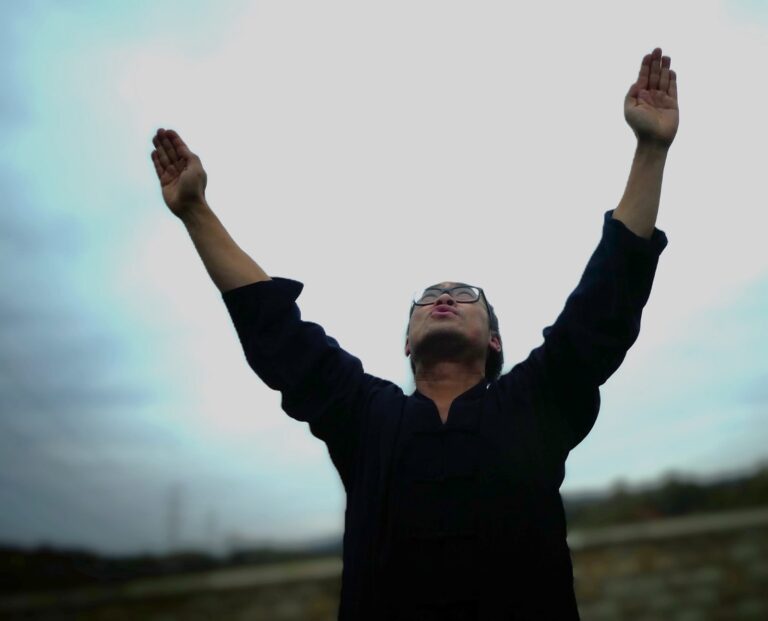
One of the most accessible Taoist exercises for managing stress is called Happy Days. To practise this, stand with your heels together and toes apart, relaxed but alert. As you inhale, cross your arms in front of the body (left hand over right) and raise them above your head, unfolding so the fingers point upwards. At the same time, lift your heels to stand lightly on your toes. As you exhale, lower your arms to the sides while bringing your heels gently back to the floor. Repeat with the opposite hand in front and complete three or four slow cycles.
With each breath, feel the lungs expanding and releasing. This exercise harmonises breath, balance, and movement. It creates a feeling of buoyancy in the chest and lightness in the heart. Even a few minutes of practice can settle the nervous system, ease anxious thoughts, and leave you calm and energised. It is a perfect ritual while waiting for the kettle to boil; a joyful pause in the day that reminds us to breathe deeply and live lightly.
A short video on Happy Days can be found below:
Notes:
- Karta, Amy, et al, 2025, Neurobiological substrates of altered states of consciousness induced by high ventilation breathwork accompanied by music, online https://journals.plos.org/plosone/article?id=10.1371/journal.pone.0329411
- Ma, Xiao, et al, 2017, The Effect of Diaphragmatic Breathing on Attention, Negative Affect and Stress in Healthy Adults, Frontiers in Psychology, doi: 10.3389/fpsyg.2017.00874, online https://www.frontiersin.org/journals/psychology/articles/10.3389/fpsyg.2017.00874/full
- Wei Marlynn, 2016, New Study Finds Yoga Breathing Lowers Inflammation, online https://www.psychologytoday.com/gb/blog/urban-survival/201610/new-study-finds-yoga-breathing-lowers-inflammation
#daoyin #breathwork #stressrelief #anxietyrelief #happydays
